

Mouse Droppings vs Rat Droppings: How to Tell Them Apart
The short answer
Mouse droppings are about 3–6 mm long with pointed ends — roughly the size of a grain of rice. Rat droppings are about 12–18 mm with blunt ends, closer to an olive pit. Size is the giveaway: if you can clearly make out the shape of a single pellet while standing upright, you are looking at rat poop, not mouse poop.
That distinction matters more than it sounds. Mice and rats need different trap sizes, different placement and different entry-point sealing, so getting the identification wrong usually means buying the wrong equipment twice.
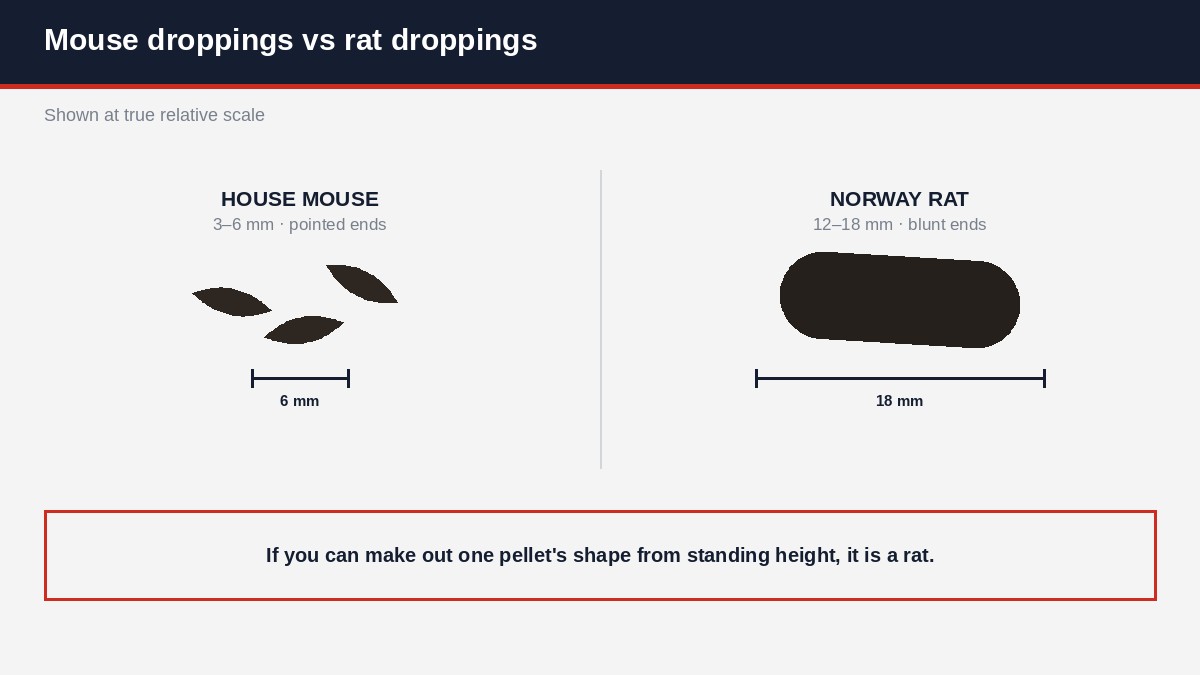
Mouse poop vs rat poop: the comparison
| House mouse | Norway rat | Roof rat | |
|---|---|---|---|
| Length | 3–6 mm | 12–18 mm | 10–13 mm |
| Thickness | 1–2 mm | About 6 mm | About 4 mm |
| Ends | Pointed, both ends | Blunt, rounded | Tapered, pointed |
| Shape | Thin, slightly curved | Capsule, chunky | Curved, slimmer |
| Compare to | Grain of rice | Olive pit | Large raisin |
| Per day | Roughly 50–75 | Fewer, much larger | Fewer, much larger |
| Usually found | Drawers, cupboards, behind appliances, insulation | Basements, garages, along foundations, near bins | Attics, rafters, upper floors |
| Other signs | Fine gnaw marks, faint night scratching | Greasy smear marks, burrows outside, heavy gnawing | Smear marks high up, daytime attic noise is not rats |
One caution on that last row. Sources disagree about whether rats concentrate droppings in fixed latrine spots or scatter them as they travel, and behaviour varies by species and situation. Size and shape are the reliable tests — where you find them is supporting evidence, not proof.
What mouse droppings look like
A house mouse dropping is 3–6 mm long and 1–2 mm thick, tapered to a point at one or both ends. Fresh ones are dark brown to nearly black, soft, and slightly glossy. The grain-of-rice comparison holds up well in practice.
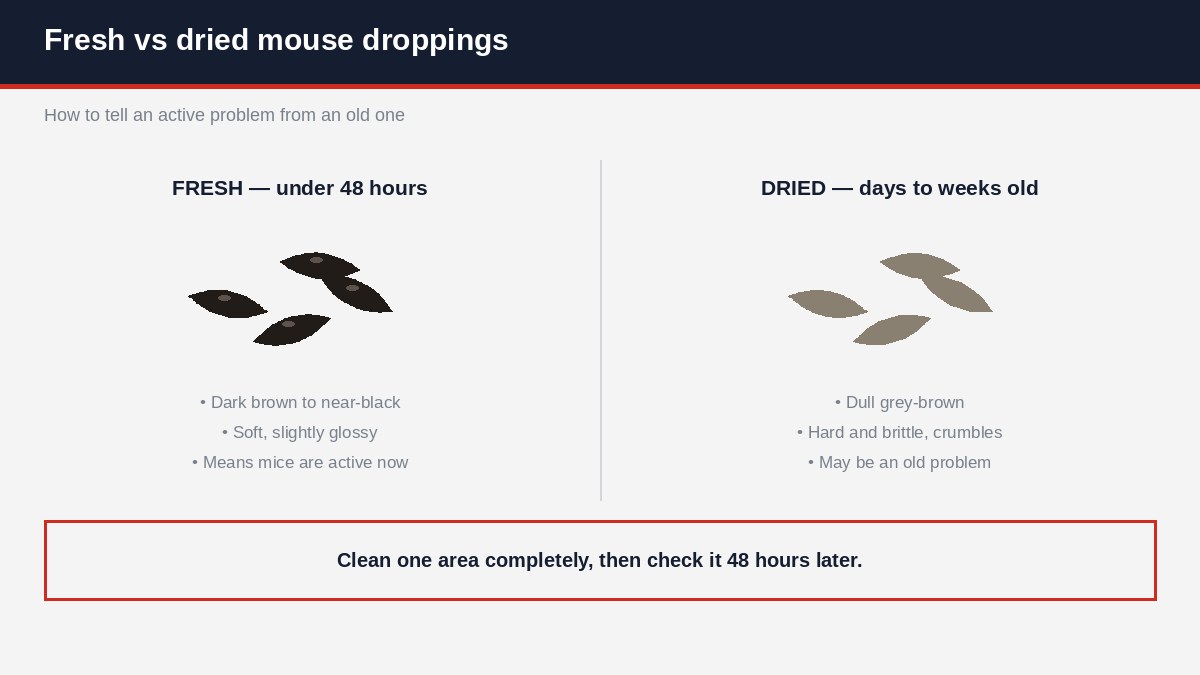
Fresh vs dried mouse droppings
Age tells you whether the problem is live, which matters more than the droppings themselves.
- Fresh, under 48 hours: dark, moist-looking, faintly shiny. Soft if pressed with a tool — never test this with bare hands.
- Dried, days to weeks old: dull, grey-brown, hard and brittle. Dried mouse droppings crumble rather than squash.
Here is the most useful test you can run at home, and it costs nothing. Clean one area completely, then check it 48 hours later. Fresh droppings mean an active infestation. Nothing new after several days suggests the activity has stopped or moved elsewhere in the house. Do this before you spend money on treatment — it tells you whether you are solving a current problem or cleaning up an old one.
Where they turn up
Mice follow walls and stay close to cover, so the evidence appears in predictable places: inside and under kitchen drawers and lower cupboards, behind the stove and fridge, along basement baseboards, in attic insulation and around ductwork, inside stored boxes, and under sinks near plumbing gaps.
Older Toronto housing gives them far more options than newer builds. Pre-war semis, century homes, rubble foundations and cold cellars all offer gaps that modern construction closes by default, which is why the same neighbourhoods generate repeat calls every autumn.
What rat droppings look like
Rat poop is large enough that most people identify it correctly on sight. At roughly 12–18 mm, a Norway rat dropping is about the length of the first joint of your little finger, thick and capsule-shaped with blunt ends.
Two species turn up in the GTA. The Norway rat is by far the more common — the ground-level rat found in basements, garages and around waste storage. The roof rat is smaller and climbs, leaving slimmer, more tapered droppings higher up in attics and rafters.
Rat activity brings evidence mice do not leave: greasy dark smear marks where oily fur brushes the same route repeatedly, gnaw damage on hard materials like plastic pipe and wood trim, and burrow holes in soil near foundations.
Rat vs mouse: how to tell the animals apart
If you have actually seen the culprit, the animal settles it faster than the droppings do. Working out whether you have a mouse or rat from a glimpse is also where people go wrong most often, so it is worth knowing what to look at.
| Mouse | Rat | |
|---|---|---|
| Body | 7–10 cm, slender | 20–25 cm, thick and solid |
| Tail | Thin, lightly furred, as long as the body | Thick, scaly, hairless, shorter than the body |
| Ears | Large for the head | Small for the head |
| Head | Small, pointed snout | Heavy, blunt |
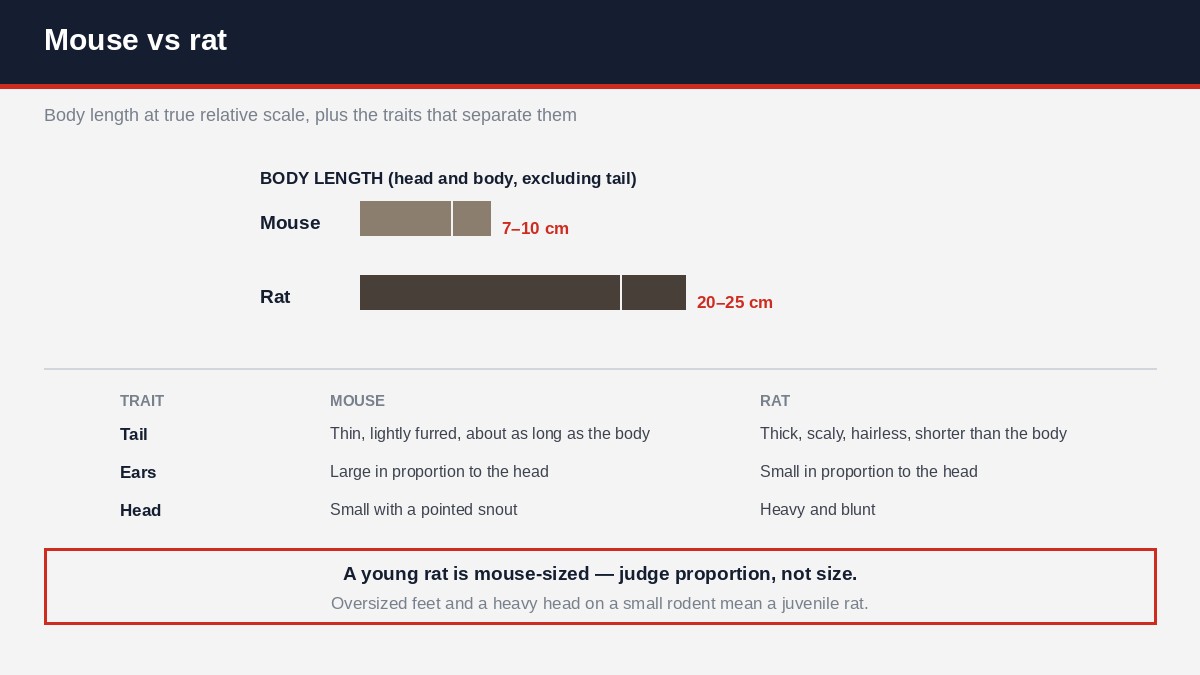
The young rat trap
This is the mistake that costs people weeks. A juvenile rat is roughly mouse-sized and gets misidentified constantly — and mouse traps will not solve a rat problem.
Proportion gives it away. A young rat has oversized feet and a heavy head relative to its body, like a puppy that has not grown into itself. A mouse is proportionally balanced at every age. If something looks mouse-sized but clumsy and big-footed, treat it as a rat until proven otherwise, and check the droppings — even a juvenile rat leaves droppings noticeably larger than a mouse's.
What the sounds tell you
What you hear narrows things down before you find anything:
- Light, fast scratching inside walls or ceilings after dark — mice. Faint and high-pitched, often described as rustling in the wall cavity.
- Heavier thumping, dragging and gnawing — rats. Louder, slower, more deliberate.
- Daytime scratching and thumping overhead — usually not rodents at all. That is squirrels or raccoons in the attic.
Rule out the lookalikes
Not every small dark pellet is a rodent dropping, and getting this wrong sends you after the wrong pest entirely.
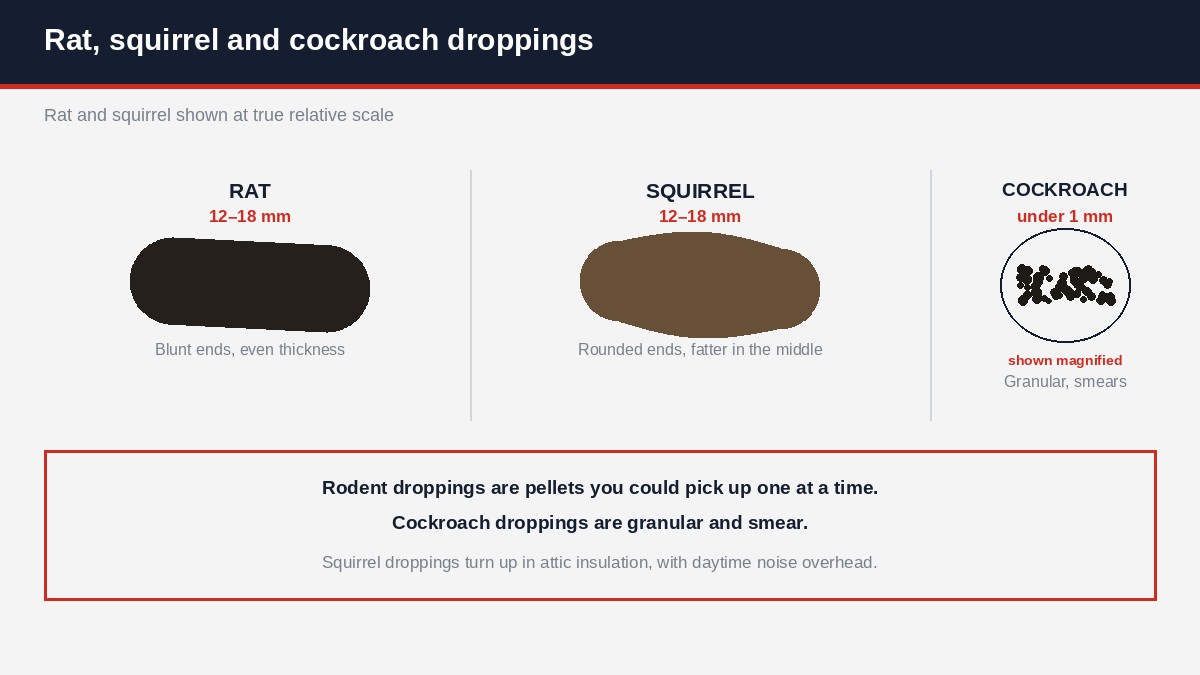
Squirrel droppings
The most common mix-up in attic situations. Squirrel droppings are similar in length to rat droppings but lighter brown, with rounded rather than pointed ends, and more barrel-shaped — slightly fatter in the middle.
Sound and timing decide it. Daytime noise overhead with droppings scattered across attic insulation means squirrels; night-time noise inside walls means mice or rats. Attic wildlife needs a different approach from rodent control, which is what our humane wildlife removal service covers.
Mouse droppings vs roach droppings
These differ in kind, not just size, and people confuse them constantly in kitchens. German cockroach droppings look like ground black pepper or coffee grounds — specks under 1 mm, often appearing as dark smears or staining rather than discrete pellets, concentrated in warm hiding spots like cabinet seams and behind kick plates. Larger roach species leave small cylindrical droppings with ridged sides.
The quick test: rodent droppings are individual pellets you could pick up one at a time. Roach droppings are granular and smear. If it is the latter, cockroach removal is the right starting point.
Bat guano
Similar in size to mouse droppings, but it crumbles to a glittery powder when disturbed because it is made almost entirely of insect fragments, and it accumulates in piles beneath a roost rather than scattering along travel routes.
If you suspect bats, stop and call a licensed professional — do not seal anything. Bats are protected in Ontario under the Fish and Wildlife Conservation Act, with additional Endangered Species Act protection for species such as the little brown bat, and penalties can reach $25,000. Exclusion is also seasonally restricted: it cannot be done during maternity season, roughly May to early August, because flightless pups would be sealed in.
Other lookalikes
Dark seeds, bits of potting soil and dried pet food crumbs all get mistaken for droppings. Rodent droppings are uniform in size and shape because they come from the same animal — a scattering of pellets that vary noticeably is usually not a pest at all.
Are mouse droppings harmful?
A fair question, and most articles answer it with US-context hantavirus statistics that do not describe a Toronto home. Here is the more useful version, focused on what droppings specifically carry.
Hantavirus: the real risk here
In North America, the hantavirus causing Hantavirus Pulmonary Syndrome is Sin Nombre virus, and the Public Health Agency of Canada identifies its primary Canadian host as the deer mouse — a wild species of wooded areas and open fields, recognisable by large eyes and ears and a two-tone coat with a white belly.
Five North American rodents are known to carry hantaviruses: the deer mouse, white-footed mouse, red-backed vole, cotton rat and rice rat. The house mouse — the mouse in virtually every Toronto kitchen and basement — is not on that list.
Ontario has not reported a single case of hantavirus pulmonary syndrome since the disease became reportable here in 2001. Canadian cases are concentrated in rural parts of Manitoba, Saskatchewan, Alberta and British Columbia, and remain rare nationally, though the infection is serious when it does occur.
Deer mice do live in Ontario, so the risk is not zero in the right setting. If you are clearing out a cottage, rural shed, barn or outbuilding that has been closed up — particularly in spring or early summer — take the full precautions below and treat it seriously.
One important caveat: the Public Health Agency of Canada advises treating all rodent droppings, urine, saliva and nesting material as potentially harmful, regardless of species. Most people cannot reliably tell a deer mouse from a house mouse, and hantavirus is not the only thing droppings carry. The cleanup method below is the same either way, which is why the practical advice does not change.
What droppings from house mice actually carry
Less dramatic than hantavirus, considerably more likely:
- Salmonella — shed in droppings and picked up from contaminated food, prep surfaces and stored dry goods.
- Leptospirosis — spread through rodent urine, usually via contaminated water or damp ground. More of a concern with wet basements.
- Lymphocytic choriomeningitis (LCMV) — the house mouse is the primary host. Most healthy people recover, but it can cause serious illness for people who are pregnant or immunocompromised.
- Mouse allergen — carried in urine, dander and droppings, and a well-documented asthma trigger with strong evidence in children. This is the most under-appreciated risk in family homes.
How long do droppings stay hazardous?
As allergens and bacterial contaminants, indefinitely. Age does not make them safe, and dried mouse droppings still need careful handling.
Viral risk works differently. The CDC protocol is to trap and seal first, then keep trapping for a week: if nothing is caught in that week, the active infestation is over and enough time has passed that virus in urine, droppings or nesting material is no longer considered infectious. That week does double duty — it confirms the problem is gone and covers the viability window.
How to clean up mouse droppings safely
Never sweep or vacuum them
This is the rule that matters most. Dry sweeping or vacuuming aerosolises fine particles — dried faecal matter, urine residue, dander — into the air you are breathing in an enclosed room. Every public-health cleanup protocol is built on one principle: keep everything wet so nothing becomes airborne. A household vacuum makes it worse, not better, because it exhausts fine particles back into the room.
Stop the infestation first
Clean up after you have stopped the source, not before, or you will repeat the job next week. Trap and seal entry points first, then clean once activity stops. Sealing is the part most people skip — our guide to finding and sealing rodent entry points covers that in detail.
What you need
- Rubber or plastic gloves — the baseline the CDC protocol calls for
- An N95 respirator and goggles if the infestation is heavy, the space is enclosed or poorly ventilated, or there is a large accumulation. A cloth or surgical mask is not equivalent — those filter dust, not fine aerosols
- An EPA-registered household disinfectant, or bleach at 1 part to 9 parts water, mixed fresh
- Paper towels and two garbage bags
The steps
- Ventilate. Open windows and doors, leave the area, and stay out for 30 minutes. Cross-ventilation beats a single window.
- Put on gloves before re-entering, plus respirator and goggles if the situation calls for it.
- Spray until very wet with disinfectant or bleach solution, and let it soak five minutes. The contact time does the work.
- Wipe up with paper towels. Never sweep, never vacuum.
- Double-bag, seal, and place in your outdoor bin.
- Disinfect the surrounding area — mop hard floors, wipe counters, cabinets and drawers.
- Launder affected fabric and bedding in hot water, dry on high heat.
- Wash your gloved hands with soap and water before taking the gloves off, then remove them and wash again.
If exposed insulation is contaminated, bag it for removal and do that work outdoors, standing upwind.
Heavy contamination, droppings in ductwork or HVAC, and anything in a commercial kitchen or food-handling area should go to a professional. Contaminated ventilation is not a DIY job — it distributes the problem through the whole building.
"I accidentally vacuumed mouse droppings"
Common, and usually fine. Ventilate the room well, empty the vacuum outdoors into a sealed bag while wearing a mask, and wipe out the canister with disinfectant. Replace a disposable bag or filter. In a Toronto home with house mice, the realistic risk is low. Watch for flu-like symptoms with fever and muscle aches over the following weeks and see a doctor if they appear — but this is not a cause for alarm.
Found mouse droppings but no mouse?
Extremely common, and it does not mean the problem resolved itself. Mice are nocturnal and actively avoid people, so most homeowners find the evidence long before seeing an animal. A single mouse leaves 50–75 droppings a day, which is why the evidence builds up fast while the animal stays invisible.
Run the 48-hour test from earlier: clean one area completely and check back. Fresh droppings mean active. If nothing new appears after several days, check whether the activity has simply relocated to a quieter part of the house rather than assuming it has gone.
Rats or mice: which is the bigger problem?
Neither is trivial, but they fail differently.
Mice reproduce faster and spread more widely through a house. They are the more common Toronto household rodent by a wide margin, and a small problem becomes a structural one quickly.
Rats are harder to eliminate. They are more cautious around new objects, which slows trapping, and they cause more serious structural and electrical damage. They also tend to arrive from outside through burrows and sewer connections rather than nesting purely indoors.
The practical difference: a mouse problem is usually solved inside the house, while a rat problem usually means exterior entry points, burrows or waste storage need attention too.
When to call a professional
Persistent droppings after DIY trapping almost always means the entry points have not been found. Mice fit through a gap the width of a pencil — about 6 mm — and rats need roughly 12 mm, so sealing is precise work. Trapping without exclusion is an ongoing cost, not a fix.
Worth calling for:
- New droppings still appearing after two weeks of trapping
- Droppings in insulation, ductwork or wall cavities
- Any rodent evidence in a food-handling or commercial space
- Large droppings suggesting rats, particularly with burrows outside
- Repeat infestations across seasons, which nearly always mean an unsealed structural gap
Pesticon handles mice control and rat and rodent control across Toronto and the GTA, including inspection, entry-point sealing and follow-up monitoring. See where we work on our service areas page, or request a free estimate.
Frequently asked questions
How do I tell if droppings are from a mouse or a rat?
Size is the most reliable indicator. Mouse droppings are about 3–6 mm with pointed ends, like a grain of rice. Rat droppings are about 12–18 mm with blunt ends, closer to an olive pit. If you can clearly see the shape of one pellet from standing height, it is a rat.
How do I tell a rat from a mouse if I have seen the animal?
Look at proportion rather than size alone, since a young rat is mouse-sized. A mouse has large ears for its head, a small pointed snout, and a thin lightly furred tail about as long as its body. A rat has small ears on a heavy blunt head and a thick, scaly, hairless tail shorter than its body. Oversized feet on a small rodent mean a juvenile rat.
Are mouse droppings harmful?
They carry real but manageable risk. The main concerns in a Toronto home are salmonella from contaminated food surfaces and mouse allergen, which is a well-documented asthma trigger in children. Hantavirus risk is very low here — the house mouse is not among the North American rodents known to carry it, and Ontario has reported no cases since 2001. Health Canada still advises treating all rodent droppings as potentially harmful, so clean up properly either way.
What should you do if you see mouse droppings?
Do not sweep or vacuum. Ventilate the room for 30 minutes and stay out of it, put on gloves, spray the droppings until very wet with disinfectant, let them soak five minutes, wipe up with paper towels, double-bag the waste, disinfect the surrounding surfaces, then wash your hands. Add an N95 respirator and goggles if the infestation is heavy or the space is enclosed.
Why do I see mouse poop but no mice?
Mice are nocturnal and avoid people, and one mouse leaves 50–75 droppings a day. Finding evidence without seeing an animal is the normal pattern, not a sign the problem is over.
What could be mistaken for mouse droppings?
Cockroach droppings, which are much smaller and pepper-like; squirrel droppings, which are larger, lighter brown and barrel-shaped; bat guano, which crumbles to a glittery powder; and non-pest lookalikes such as dark seeds or dried pet food.
How do I tell rat droppings from squirrel droppings?
They are similar in length. Squirrel droppings are lighter brown with rounded ends and a barrel shape, scattered through attic insulation. Rat droppings are darker with blunt ends and follow wall routes. Daytime attic noise means squirrels; night-time wall noise means rodents.
How long do mouse droppings stay dangerous?
As an allergen and bacterial contaminant, indefinitely — age does not make them safe. Viral risk drops substantially once the infestation is gone and about a week has passed, but they still need proper removal.
Can I get sick from touching mouse droppings with bare hands?
The main risk is transferring bacteria to your mouth or to food. Wash thoroughly with soap and water, avoid touching your face, and disinfect anything the droppings touched.
Are rats harder to get rid of than mice?
Generally yes. Rats are more cautious around new objects, which slows trapping, and they usually enter from outside — so the fix involves exterior sealing and burrow work, not just indoor traps. Mice are easier to trap individually but reproduce faster and spread further through a house.
What disinfectant should I use on mouse droppings?
Any EPA-registered household disinfectant, or a fresh bleach solution at 1 part bleach to 9 parts water. Mix bleach fresh — it loses effectiveness once diluted and stored.

10X HomeStars Best of Awards Winner
Related Articles
Pesticon Receives HomeStars Best of Awards 2026 for Excellence in Pest Control
Pesticon has been recognized with the HomeStars Best of Awards 2026 for excellence in pest control services in Toronto. Learn about our award-winning services a
Read article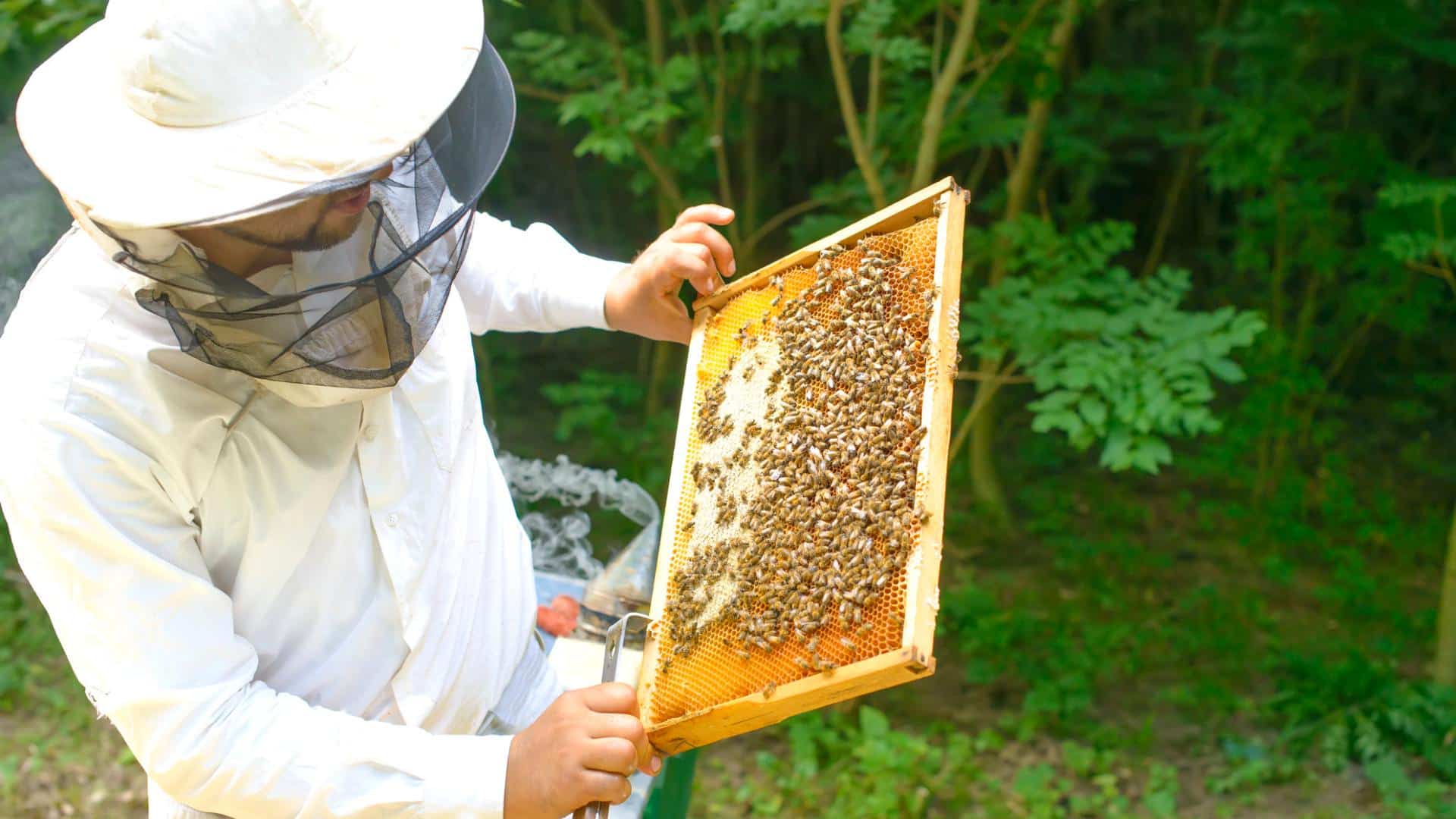
Bee Removal in Toronto: Signs, Safe & Humane Solutions (2026)
If you’ve noticed bees swarming around your Toronto home, it’s likely they’re considering your walls, attic, or shed for a hive. While bees are essential pollin
Read article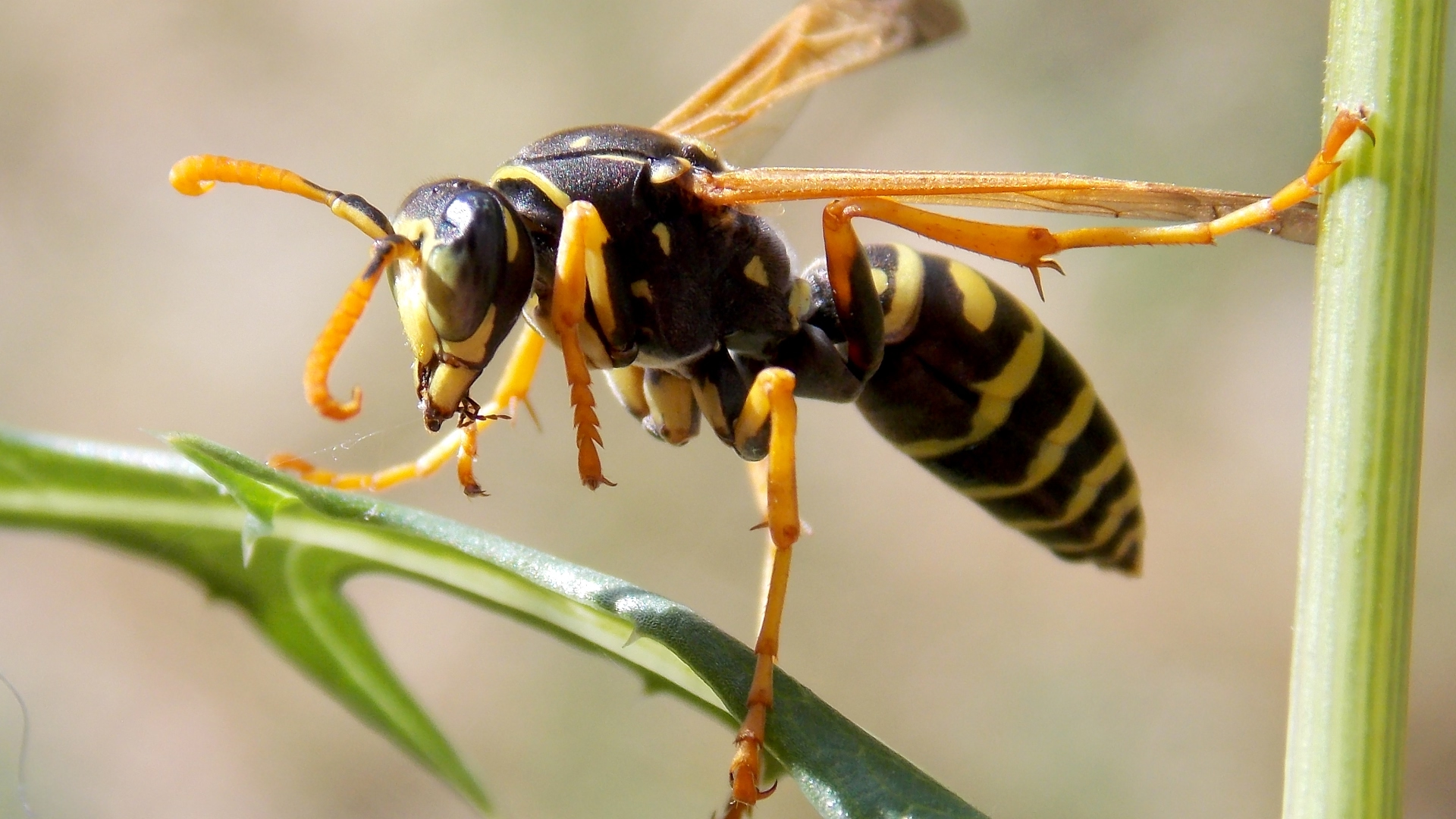
Wasp Nest Removal in Toronto: When Buzzing Becomes a Serious Problem
If you’re searching for wasp nest removal in Toronto, chances are you’ve noticed increased wasp activity around your home. Wasps can become aggressive when thei
Read article